
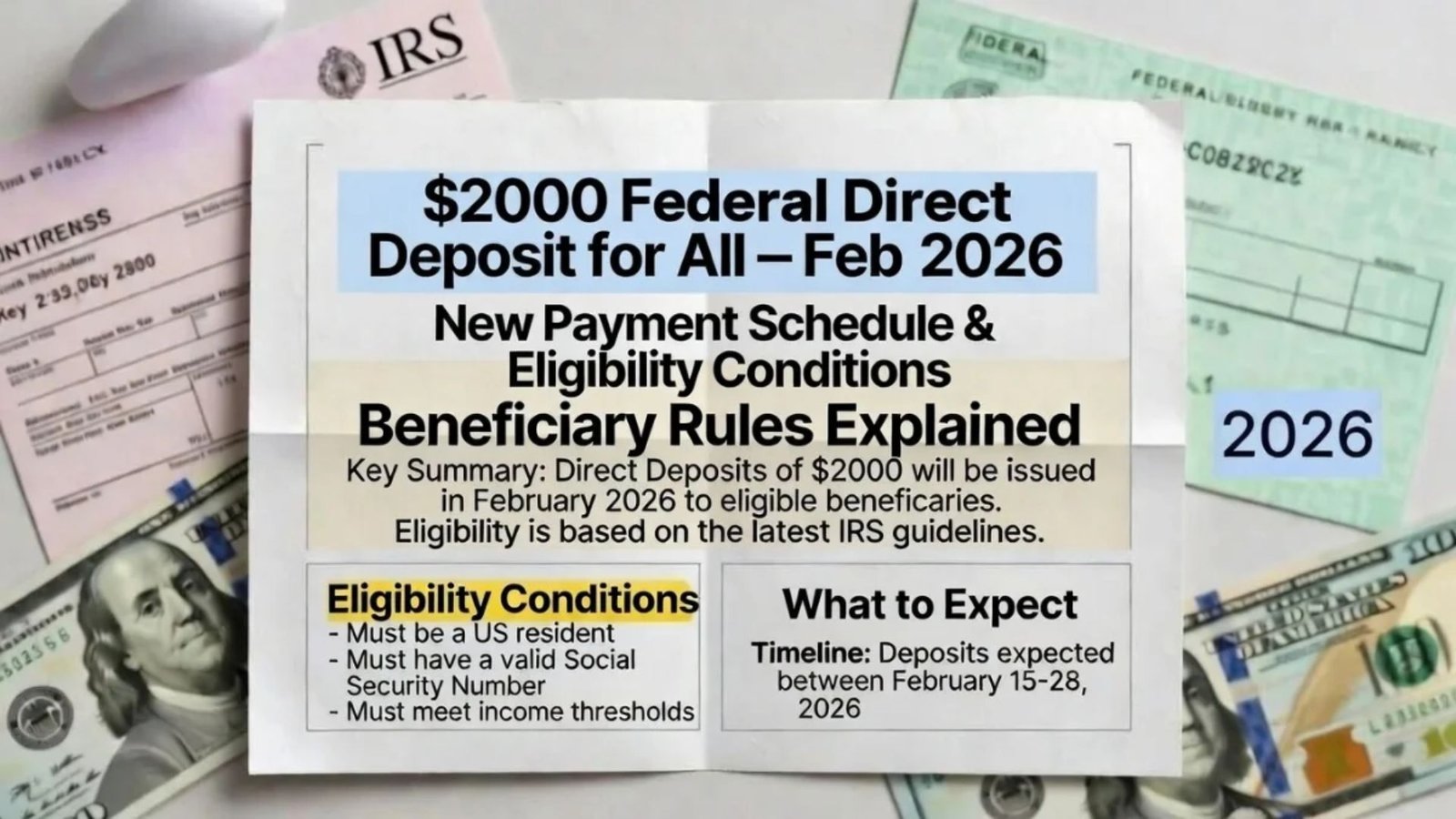
Have you spotted an unexpected $2,000 deposit in your bank account lately? Or maybe you’ve seen alerts and rumors flying around about extra federal money hitting Social Security beneficiaries? You’re not alone—millions are wondering if this is real relief or something else. In this post, we’ll break down the facts, clear up the confusion, and help you understand who might actually qualify for any legitimate federal payments tied to Social Security. Stick around to the end—you’ll walk away knowing exactly what to watch for and how to protect yourself.
What Are These $2,000 Federal Deposits?
Rumors about $2,000 federal deposits often pop up in bank alerts or social media, promising quick cash to Social Security recipients. These usually tie to ideas like stimulus checks, tariff dividends, or special relief payments. In reality, no universal $2,000 one-time federal deposit has been approved or issued to all Social Security beneficiaries in 2026. Most claims trace back to unconfirmed proposals or outright scams.
Background and Origins of the Rumors
These alerts surged in late 2025 and early 2026, fueled by talks of tariff-funded rebates or “dividends” from proposed policies. Past stimulus programs (like COVID-era payments) automatically went to many Social Security recipients via direct deposit. Today, similar rumors promise $2,000, but no legislation has passed to make it happen. Some confusion stems from retroactive Social Security payments under laws like the Social Security Fairness Act, though those aren’t fixed at $2,000.
Why This Matters for Social Security Recipients Today
With rising costs, any extra federal money could help. Social Security provides crucial income for retirees, disabled workers, and survivors. In 2026, benefits got a 2.8% COLA boost—adding about $56 monthly on average. But scams exploit this hope, tricking people into sharing personal info. Staying informed protects your hard-earned benefits.
Who Actually Qualifies? Eligibility Breakdown
No broad $2,000 deposit program exists for Social Security users right now. Legitimate federal payments (like regular benefits or rare retroactives) go to:
- Retired workers, disabled individuals, survivors
- Those with valid Social Security numbers and direct deposit setup
- Low-income SSI recipients (max federal $994 individual in 2026)
Proposed tariff rebates (if ever passed) might target lower/middle-income households, but nothing’s confirmed.
Here’s a quick comparison table:
| Payment Type | Typical Amount (2026) | Who Qualifies | Status |
|---|---|---|---|
| Standard Social Security Benefit | ~$2,071 average retirement | Workers 62+, disabled, survivors | Ongoing, monthly |
| SSI Federal Maximum | $994 individual | Low-income, limited resources | Monthly, needs-based |
| Rumored $2,000 Federal Deposit | $2,000 one-time | Unclear/no program approved | Not real/Scam risk |
| 2026 COLA Increase | +2.8% (~$56/mo avg) | All beneficiaries | Active since Jan 2026 |
Another table for common myths vs. facts:
| Myth | Fact |
|---|---|
| Everyone gets $2,000 automatically | No approved program; check official sources |
| Urgent action needed to claim | Government never demands immediate info |
| Tied to Social Security Fairness Act | Retro payments vary, not fixed $2,000 |
Notable Facts and Statistics
- Over 71 million get Social Security; average retirement benefit hit ~$2,071 after 2.8% COLA.
- SSI max: $994 individual, $1,491 couple.
- No new stimulus since 2021; past ones reached Social Security folks via SSA data.
- Scams spike with deposit rumors—FTC warns against sharing SSN or bank details.
Expert Tips to Avoid Scams and Maximize Benefits
- Verify everything at ssa.gov or irs.gov—never click links from alerts.
- Set up my Social Security account for real updates.
- Watch for red flags: threats, gift card demands, unsolicited calls.
- If eligible for any adjustment, it hits your existing direct deposit—no action usually needed.
- Report suspicious messages to SSA or FTC.
Frequently Asked Questions (FAQs)
Q: Is there a $2,000 deposit coming to my Social Security bank account?
A: No confirmed program exists. Rumors are often scams.
Q: Who gets the 2026 COLA increase?
A: All beneficiaries—about $56 more monthly on average.
Q: How do I check real payments?
A: Use official sites or your my Social Security account.
Q: Are tariff dividend checks real?
A: Proposed but not enacted—don’t share info to “claim” them.
Q: What if I see a mystery deposit?
A: Contact your bank and SSA; it could be a legitimate adjustment or error.
Wrapping It Up
The $2,000 federal deposit alert sounds exciting, but for Social Security folks in 2026, focus on real boosts like the 2.8% COLA and steady monthly benefits. Scams thrive on confusion, so verify everything officially and protect your info. Stay proactive—check ssa.gov regularly, set up alerts wisely, and share this with friends relying on Social Security. Your financial security matters—keep scrolling for truth over hype!